

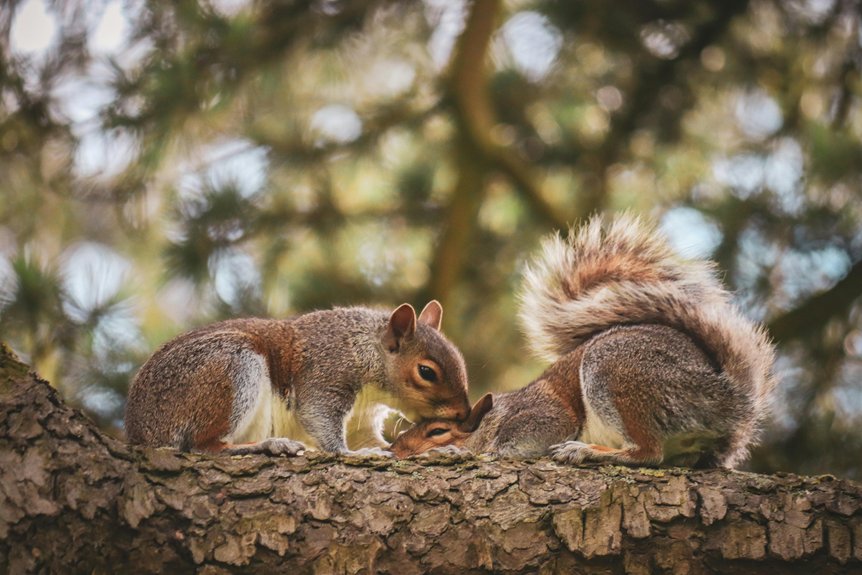
Inside squirrel nest videos teach you how these animals communicate through vocalizations and tail movements, revealing social hierarchies and territorial behaviors. You’ll see their careful choice of nesting materials, feeding and grooming routines, and maternal care essential for offspring survival. The videos also highlight squirrels’ adaptability to urban settings, showing how they use man-made structures and modify foraging habits. These observations offer a clearer picture of wildlife complexity and survival strategies in changing habitats. Exploring further uncovers even more nuanced behaviors.
Observing Squirrel Behavior and Social Interactions
When you observe squirrel nests closely, you gain valuable insights into their behavior and social interactions.
You notice that squirrel communication involves a combination of vocalizations, tail movements, and body postures, which help them convey warnings or establish territory. Understanding this communication sheds light on their complex social hierarchy, where dominant individuals often control prime nesting sites and access to resources.
Insights Into Nesting and Parenting Strategies
Although squirrel nests may appear simple at first glance, they reveal intricate nesting and parenting strategies essential for the survival of their young.
You’ll notice squirrels carefully select nesting materials like leaves, twigs, and soft moss to create insulated, protective environments. Their nurturing techniques involve frequent feeding and grooming, ensuring offspring develop properly.
Mothers maintain the nest’s cleanliness and adjust its structure as needed, demonstrating adaptability. By observing these behaviors, you gain insight into how squirrels balance shelter, safety, and care, which highlights their survival skills in the wild.
This knowledge enriches your understanding of wildlife’s complexity.
Understanding the Impact of Urban Environments on Squirrels
Observing squirrels’ nesting and parenting habits gives you a solid foundation for understanding how these animals adapt to their surroundings.
Urban adaptation plays a critical role as squirrels navigate habitat loss caused by expanding cities. You can notice how squirrels adjust their behaviors to survive in urban spaces.
Key points include:
- Squirrels use man-made structures to build nests, compensating for fewer natural trees.
- They alter foraging patterns to exploit new food sources like bird feeders and trash.
- Increased interaction with humans influences their risk awareness and movement.
These adaptations highlight squirrels’ resilience amid urban challenges.
Frequently Asked Questions
How Do Squirrels Choose Materials for Building Nests?
You observe that squirrels select nest materials based on availability, insulation properties, and safety.
Nest material selection involves gathering leaves, twigs, and soft fibers to build a secure, warm environment.
Nesting behavior analysis shows they prefer lightweight, flexible items that provide protection from predators and weather.
Their choices reflect an instinctive balance between comfort and concealment, ensuring their nests support survival without unnecessary exposure or energy expenditure.
What Predators Most Commonly Threaten Squirrel Nests?
You’ll find that common predators threatening squirrel nests include snakes, raccoons, and birds of prey like hawks and owls.
Squirrels’ nesting behaviors focus heavily on predator avoidance, selecting concealed locations and sturdy materials to protect their young.
Can Watching Squirrel Nests Help in Pest Control?
Yes, watching squirrel nests can aid pest management by revealing squirrel behavior patterns that impact local ecosystems.
You’ll observe how squirrels interact with insects and other small animals, sometimes reducing pest populations naturally.
Understanding their nesting habits and activity cycles helps you predict when squirrels might influence pest control.
This knowledge supports informed decisions for managing pests while maintaining ecological balance, offering a non-invasive approach aligned with wildlife conservation principles.
How Long Do Squirrels Typically Stay in One Nest?
Squirrels typically stay in one nest for several days to a few weeks, depending on their nesting habits and environmental conditions.
Their behavior involves frequently moving between nests to avoid predators and parasites, especially during breeding seasons.
You’ll notice they maintain multiple nests within their territory, using them as temporary shelters.
This flexibility in nest use supports their survival and freedom to adapt to changing circumstances in their habitat.
Are Squirrel Nests Reused Across Seasons?
Yes, squirrels often reuse nests across seasons, reflecting their nesting behavior and seasonal habits.
They typically maintain several nests within their territory, switching between them for safety and comfort. Reusing nests saves energy compared to building new ones.
However, squirrels may also build new nests if environmental conditions change or if old nests deteriorate.
This flexible strategy supports their survival and adapts to seasonal variations in climate and resource availability.